

The Emotional Journey of Becoming a Surrogate in Texas: Starting from the Heart
When I first considered the path to become a surrogate in Texas, my mind was filled with practical questions about the process, the legalities, and the medical steps. But what surprised me most—and what truly defines this journey—was the profound emotional landscape I would navigate. It’s a path paved with as much feeling as it is with procedure, and understanding that from the start made all the difference for me.
1. The First Stirrings: “Is This Right for Me?”
My emotional journey began with a quiet, persistent thought: I could help create a family. As a mom myself here in Texas, I knew the incomparable joy of holding my child. The idea of giving that gift to someone else was powerful. But alongside that excitement came a wave of introspection. I asked myself tough questions:
- Was my family truly ready and supportive?
- How would I feel about carrying a child that wasn’t “mine” genetically?
- Could I handle the physical and emotional commitment?
This phase wasn’t about finding instant answers, but about giving myself permission to explore every feeling without judgment. Talking it through with my spouse, and later with a professional counselor from my agency, was crucial. In Texas, reputable agencies require a mental health screening, and I came to see this not as a hurdle, but as a valuable tool to prepare my heart and mind.
“The decision to become a surrogate isn’t made in a day. It’s a series of small ‘yeses’ in your heart, each one building your confidence and clarity. For me, the strongest yes came from knowing I was doing this from a place of complete choice and empowerment.”
2. Connection & Intention: Building the Relationship
One of the most unique emotional aspects was matching with intended parents. I was nervous! Would we click? Would they trust me? I was matched with a wonderful couple from Houston, and our first video call changed everything. Hearing their story, their hopes, and their struggles made my “why” crystal clear. I wasn’t just carrying a pregnancy; I was partnering with a family to fulfill a dream.
| Milestone | Potential Feelings | What Helped Me |
|---|---|---|
| The Matching Process | Nervousness, hope, pressure to “be chosen” | Being authentically myself; remembering it’s about finding the right fit for both parties. |
| Pregnancy Test & Early Pregnancy | Eager anticipation, shared joy, early pregnancy nerves | Celebrating with my intended parents; leaning on my agency’s support team for any medical worries. |
| Feeling the Baby Move | Awe, connection, and complex questions about bonding | Sharing kick counts with the parents; journaling to process my feelings; reminding myself of my role as a nurturer. |
| The Birth & Placement | Intense pride, bittersweet happiness, physical and emotional release | Having a clear postpartum support plan; focusing on the parents’ faces; allowing myself to feel all the emotions without guilt. |
3. My Personal Anchor: The Support System
I cannot overstate this: you cannot do this emotionally alone. My support system was my lifeline. This included:
- My Family: My husband and kids were my core team. We talked openly about “helping another family have a baby.”
- My Agency: A good Texas-based agency provides more than logistics; they offer surrogate-specific support groups and counseling. Talking to other surrogates who “got it” was invaluable.
- My Intended Parents: Our open, honest relationship meant I never felt isolated in the experience.
The journey to become a surrogate in Texas is a legal and medical process, yes. But first and foremost, it is a human journey. It’s about compassion, intention, and a remarkable kind of love. By honoring the emotional path as much as the physical one, I was able to move forward with confidence, grace, and an open heart, ready for the incredible experience ahead.
My “Why”: The Heart Behind My Decision to Become a Surrogate in Texas
When I first seriously considered the path to become a surrogate in Texas, the question wasn’t just “can I do this?” but more importantly, “why do I want to do this?” For me, it wasn’t a single lightning-bolt moment, but a slow, steady calling. I had the privilege of relatively easy pregnancies and the profound joy of holding my own children. That feeling—that incomparable gift of family—was something I knew in my bones I wanted to help create for someone else. Seeing friends in our own communities, right here in places like Dallas, Houston, or San Antonio, struggle with infertility made the abstract idea of helping very, very real.
“My motivation wasn’t about being ‘pregnant for pay.’ It was about being a bridge. I had the ability to carry a child, and a family out there had the love to give but not the means to carry. Texas felt like the right place to build that bridge because the laws here are designed to protect everyone in the process, especially us surrogates.”
I also deeply considered my own family. My spouse and my kids were my first conversation. Were we emotionally ready? Did they understand that this was a baby we were helping to grow for another family? Having those honest, sometimes messy, conversations at our kitchen table in Austin was the first step in my psychological preparation. Their support became my foundation.
1. Getting My Mind and Heart Ready: More Than Just a Physical Journey
The psychological screening was one of the most valuable parts of my journey, not a hurdle. Talking with a licensed therapist who specializes in third-party reproduction helped me articulate my motivations, anticipate emotional challenges, and set up healthy boundaries from the start. We talked about everything: how I’d handle questions from strangers, the feelings I might have at birth, and my relationship with the intended parents. In Texas, this screening is a standard, protective step, and I’m so grateful for it.
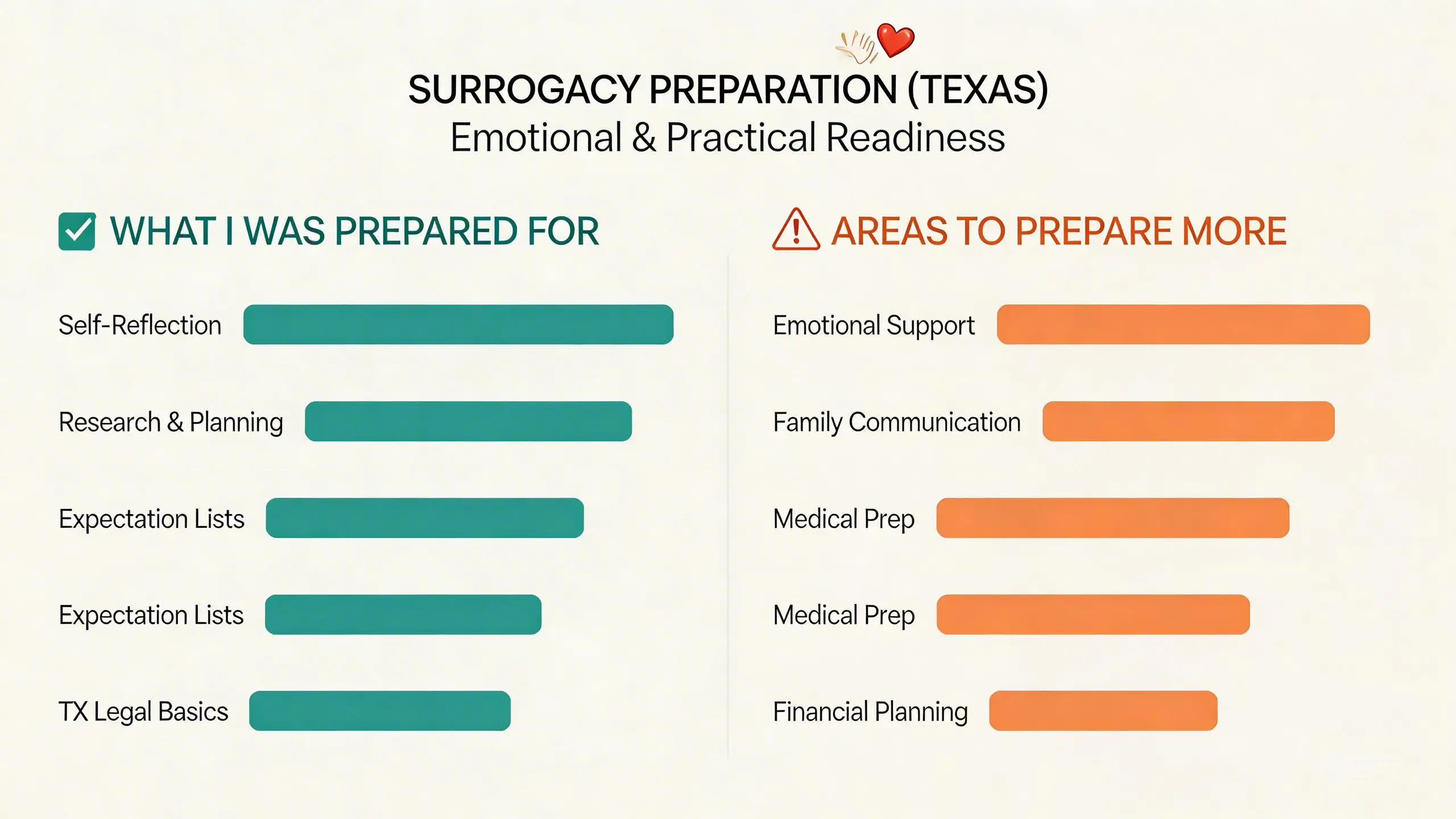
My practical preparation involved a lot of self-reflection and research. I made lists, like the one below, to clarify my own thoughts and expectations:
| What I Was Excited & Hopeful For | What I Needed to Prepare For Emotionally |
|---|---|
| The joy of the intended parents at the first ultrasound. | Managing the physical demands of pregnancy while not taking a baby home. |
| Building a unique, trusting relationship with another family. | Navigating the opinions and questions of friends and extended family. |
| The incredible sense of purpose in helping to create a family. | The postpartum period and ensuring I had a strong support system for myself. |
2. Finding My Support System: You Can’t Do This Alone
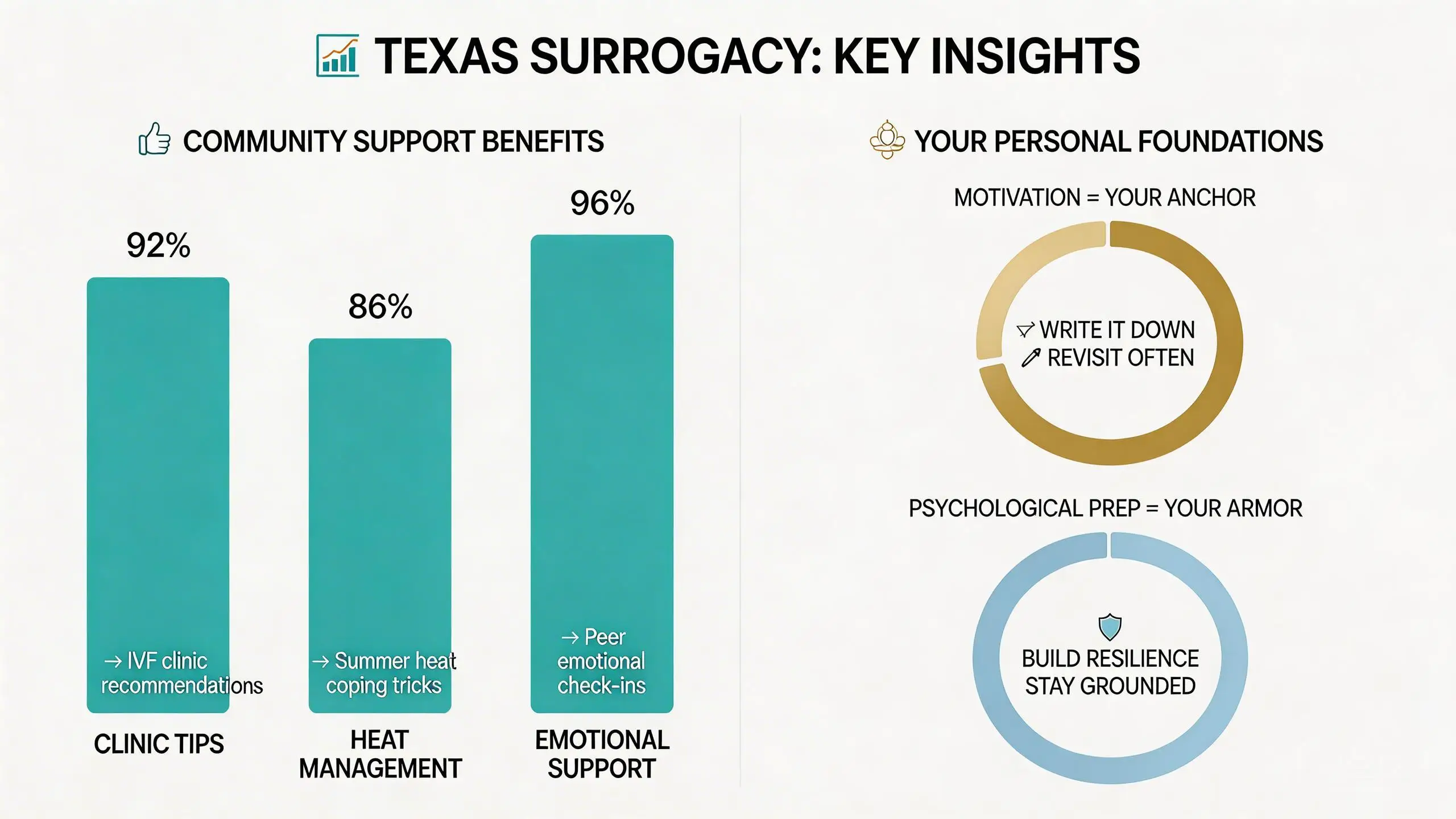
One of the best decisions I made was to build my surrogate support network early. This included my agency’s social worker, other surrogates I met through local Texas groups (both online and in-person), and my close inner circle. I learned to be very clear about what I needed—whether it was a ride to an appointment in Houston or just someone to listen after a long day.
My advice? Don’t underestimate the power of connecting with other Texas surrogates. They get it in a way others simply can’t. We share tips on the best IVF clinics, how to handle the summer heat while pregnant, and that unique emotional landscape. That camaraderie was a lifeline.
3. Embracing the Texas Surrogacy Landscape: Knowledge is Comfort
Part of my mental prep was understanding the legal framework. Texas is one of the most surrogate-friendly states, with clear statutes (like the Texas Family Code) that outline the process for establishing parentage before birth. Knowing that the intended parents’ names would go directly on the birth certificate, and that my rights and responsibilities were clearly defined by a solid legal contract, gave me immense peace of mind. It allowed me to focus on what mattered most: a healthy pregnancy and the emotional journey, not legal worries.
My final piece of insight for anyone considering this path: Your motivation is your anchor. Revisit it often. Write it down. And your psychological preparation is your armor—it’s what allows you to navigate this beautiful, complex journey with confidence and grace. Taking the time to do this inner work meant that when I finally saw those two pink lines on the test, I was ready to celebrate not just for myself, but for the family whose dream was finally coming true.
Managing Relationships with Family and Friends as a Texas Surrogate
When I first decided to become a surrogate in Texas, I was so focused on the medical and legal steps that I didn’t fully consider how this journey would ripple through my personal life. Telling my family and friends, and then managing those relationships throughout the pregnancy, became its own profound chapter. Here in Texas, where community and family ties run deep, navigating these conversations with heart and honesty was key.
1. Starting the Conversation: Sharing Your Decision
I remember the nervous flutter in my stomach before telling my parents. My advice? Choose a quiet, private moment and frame your decision from your perspective. I started by explaining my “why”: the profound desire to help a family experience the joy I had with my own children. I emphasized that this was a carefully considered choice, made with full support from my agency and within the strong legal protections Texas offers. For some friends, I used simpler terms:
“I’ve decided to carry a baby for a couple who can’t have one on their own. It’s something I feel called to do, and I’m working with an amazing team to make sure everything is safe and secure for everyone.”
Be prepared for a range of reactions—from immediate enthusiasm to confusion and concern. Give them time and space to process.
2. Setting Boundaries and Managing Expectations
Not everyone will understand, and that’s okay. With a few relatives, I had to set clear, loving boundaries. I found it helpful to establish rules early on. For example, I politely but firmly let everyone know that details about the intended parents or the embryo transfer were private. I also made it clear that while I was happy to share my own well-being, some topics were between me, my doctors, and the intended parents.
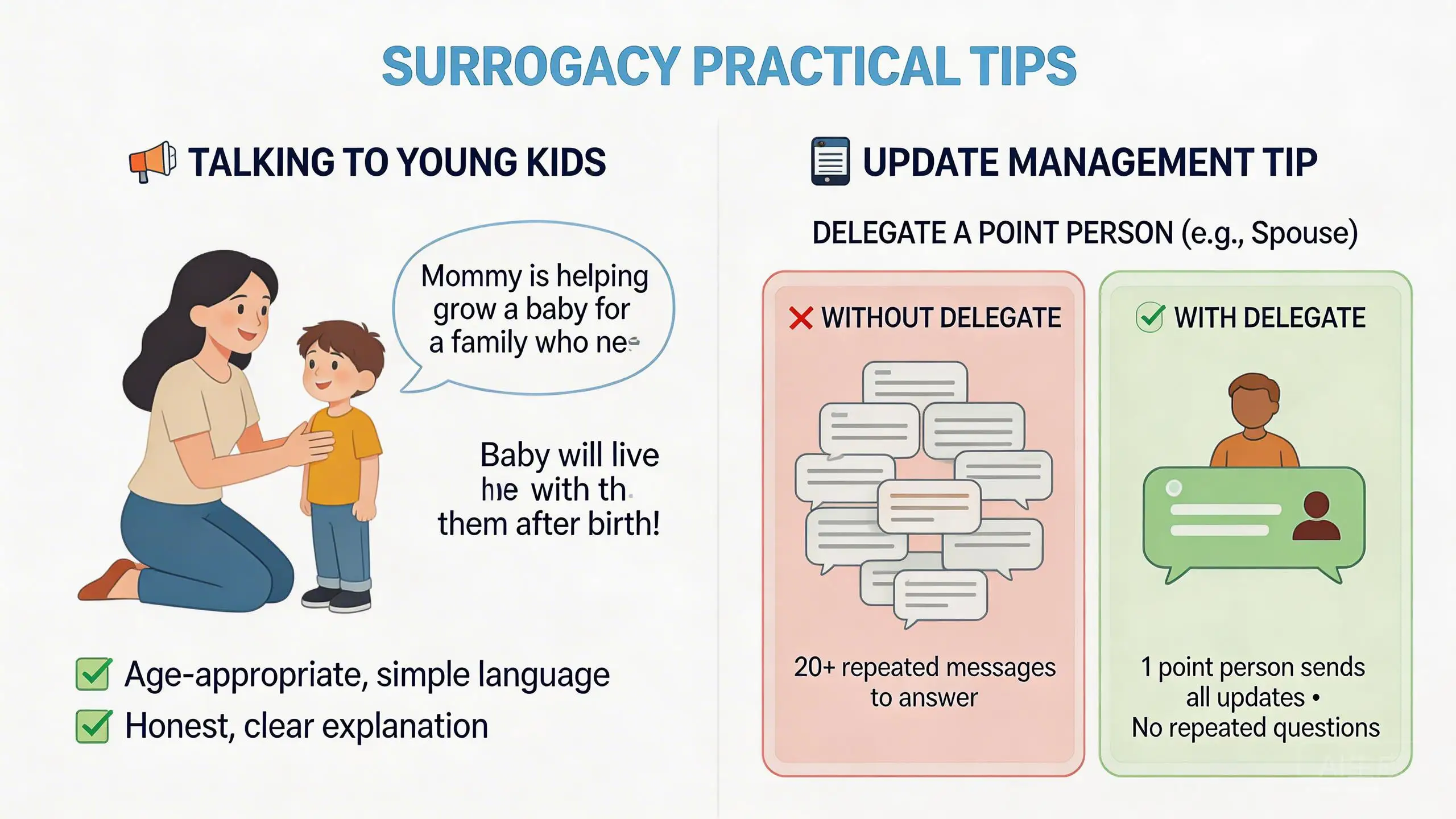
A practical tip: delegate a key person (my husband was mine) to manage updates during appointments or after milestones, so you’re not fielding the same text from 20 people.
3. Involving Your Immediate Family (Your Partner & Kids)
This was the most crucial relationship to nurture. My partner and I had many conversations before applying. We discussed the time commitment, the physical demands, and the emotional landscape. Once pregnant, we scheduled regular check-ins—just us—to make sure we were both feeling supported.
With my kids, I used age-appropriate language. For my young son, I said, “Mommy is helping to grow a baby for another family who needs help. The baby will go live with them after it’s born.” We involved them in small ways, like letting them feel kicks (which they called “the helper baby”), to make it a positive family experience.
| Question | My Typical Response (Tailored to my comfort level) |
|---|---|
| “Aren’t you going to get too attached?” | “My role is clear from the start: I’m the carrier, not the parent. The bond is one of care and purpose, not ownership. I’m focused on the family I’m helping to create.” |
| “How does this work legally in Texas?” | “Texas has great surrogacy laws. We have a detailed legal contract before any medical procedures, and the intended parents’ rights are established before birth, which gives everyone peace of mind.” |
| “Can we throw you a baby shower?” | “That’s so sweet, but we’ll be having a ‘Celebration of Helping’ instead! Gifts, if any, can go to the intended parents. I’d love your support with meals or help with my kids after the delivery.” |
4. Leaning on Your Surrogacy Community
No one understands this journey like fellow surrogates. Connecting with other Texas surrogates through my agency’s support groups was a game-changer. They were my sounding board for the unique feelings and challenges that even my closest non-surrogate friends couldn’t fully grasp. When I needed to vent about an insensitive comment or share a joyful moment from an intended parent visit, they were there.
5. Embracing the Support (and Letting Go of the Rest)
I was genuinely surprised and touched by who stepped up. A neighbor offered to carpool my kids. A friend sent encouraging texts before big appointments. Let people help you in ways that feel good. Conversely, I learned to gracefully deflect unsolicited advice or negative opinions. My mantra became:
“This is my journey, undertaken with full knowledge and support. I respect your feelings, but my decision is final and brings me joy.”
In the end, this journey strengthened some relationships, simplified others, and taught me more about compassionate communication than I ever expected. By being open, setting clear boundaries, and seeking support from those who truly get it, you can protect your peace and enjoy this incredible experience surrounded by love—even if it looks a little different than you first imagined.
Navigating the Heart Part: My Emotional Journey Through Screening & Matching in Texas
When I first decided I wanted to become a surrogate in Texas, my mind was full of excitement and purpose. I knew I could help create a family. What I didn’t fully anticipate was the emotional depth of the screening and matching process. It’s not just a series of medical checks and paperwork—it’s where the journey truly begins in your heart. Here’s what I learned, felt, and how I navigated it all right here in the Lone Star State.
1. The Vulnerability of the Psychological Screening
I remember walking into my psychological evaluation feeling confident. I had my own beautiful kids, a supportive family, and my reasons were solid. But the questions went deeper than I expected. We talked about everything: my childhood, my current relationships, how I handle stress, and my deepest motivations for doing this.
It felt incredibly vulnerable. They weren’t just checking a box; they were ensuring I was emotionally prepared for the unique challenges of surrogacy. A key concern they addressed was my support system. In Texas, where families can be spread across vast distances, having a solid, local support network was crucial.
“The psychologist helped me realize this wasn’t an invasion of privacy, but a protection—for me, for my family, and for the intended parents. It ensured we were all set up for success from the very start.”
2. The “What Ifs” During Medical Clearance
After I was psychologically cleared, the medical screening at the fertility clinic began. This is where the “what ifs” started creeping in. What if they find something wrong with me? What if my body isn’t as capable as I believe it is? Even though I’d had healthy pregnancies, the fear of rejection was real. It’s a strange feeling to have your own body “audition” for a role you so deeply want.
The process was thorough—blood work, ultrasounds, a physical exam. My advice? Ask every question. The nurses and doctors in the Texas clinics I worked with were amazing at explaining each step. Understanding the “why” behind each test helped calm my nerves and made me feel like an active participant, not just a subject.
3. The Rollercoaster of Matching: Finding “Your” Family
This was, without a doubt, the most emotionally charged part for me. Reviewing intended parent profiles felt like a huge responsibility. I wasn’t just looking for a match on paper; I was looking for a connection.
My agency presented me with a few profiles, and I read each one multiple times. I considered their story, their values, and what they hoped for in a surrogate. When I read the profile of the couple I eventually matched with—a couple from Houston who had been trying for years—I just knew. But then came the anxiety: Will they like me?
My Matching Meeting: A Texas-Sized Case of Nerves
We arranged a video call (they were in Houston, I was in Dallas). I was so nervous! But we quickly bonded over our love for Texas summers (even the brutal heat!) and our shared vision for a communicative, trusting journey. The match felt right. However, it’s normal to not feel an instant “spark” with every profile. It’s okay to say no until you find the right fit. Here’s a quick breakdown of what I considered:
| What I Thought About | Why It Mattered to Me |
|---|---|
| Communication Style | Did they want daily updates or a weekly check-in? Finding alignment here prevents stress later. |
| Views on Pregnancy | Their comfort level with my daily life, diet, and activities was important for mutual respect. |
| Location & Involvement | Living in the same state (Texas) meant they could potentially attend key appointments, which we all wanted. |
| Legal Clarity | Texas has surrogacy-friendly laws, but ensuring we were both clear on the legal process was essential for peace of mind. |
4. Practical Advice for Your Heart & Mind
Looking back, here’s what I wish I could tell my earlier self during the screening and matching phase:
- Embrace the Process: The screenings aren’t hurdles; they’re the foundation. They protect everyone and build a safe path forward.
- Trust Your Gut: During matching, if something feels off, it’s okay to pause. This is a profound relationship you’re building.
- Lean on Your Agency: A good Texas-based agency is your guide and advocate. Mine was invaluable in facilitating the match and translating my feelings into clear next steps.
- Talk to Your Partner/Family: Keep them in the loop. Their support through the emotional ups and downs of this phase is everything.
The screening and matching process taught me that becoming a surrogate in Texas is as much an emotional commitment as a physical one. It prepared me, tested my resolve, and ultimately led me to the family I was meant to help. It’s where my “why” became crystal clear, and for that, every moment of vulnerability was worth it.
Building Emotional Connections with Intended Parents: My Heartfelt Journey in Texas
When I first decided to become a surrogate in Texas, I knew the medical process would be significant. But what truly shaped my journey was the emotional landscape—specifically, building a genuine connection with my intended parents. This wasn’t just a clinical arrangement; it was the creation of a unique, trusting relationship that would carry us through nearly a year of shared hopes. Here’s what I learned about fostering that irreplaceable bond.
1. The Foundation: Finding Your “Match” in Texas
In Texas, the matching process is taken very seriously by reputable agencies. For me, it wasn’t just about profiles on paper; it was about shared values and communication styles. My agency facilitated several video calls before we officially matched. I remember being nervous before that first call, but we instantly connected over our love for Texas summers and similar senses of humor. That initial “click” is so important. Don’t rush it. Ask the questions that matter to you:
- What are your hopes for communication during the pregnancy?
- How do you envision your involvement in appointments, especially if you’re coming from out of state?
- What does “family” mean to you?
Because Texas law is surrogacy-friendly and requires clear legal contracts, having emotional alignment before the legal process made everything feel more collaborative and less transactional from the start.
2. Navigating Communication: Setting the Tone Early
Once matched, we had an open conversation about communication. We decided to use a group chat for quick updates and scheduled a weekly video call. This routine gave us structure but also felt natural. I made it a point to share not just big milestone updates, but little things too—like when I felt the first flutter in Austin’s Zilker Park. It helped them feel connected to the everyday experience.
“The weekly calls weren’t just check-ins; they became a space where we shared our lives. They’d tell me about preparing the nursery in Dallas, and I’d share my toddler’s latest antics. We were building a friendship, not just a surrogacy arrangement.”
3. Involving Them in the Texas-Sized Journey
Geography can be a factor, even within Texas. My intended parents lived in Houston, while I was in San Antonio. We planned which appointments they could attend in person. Seeing their faces light up on the ultrasound screen at a San Antonio clinic is a memory I’ll forever cherish. For appointments they couldn’t make, I’d record the heartbeat on my phone or have them on FaceTime. These efforts made them feel included and solidified our partnership.
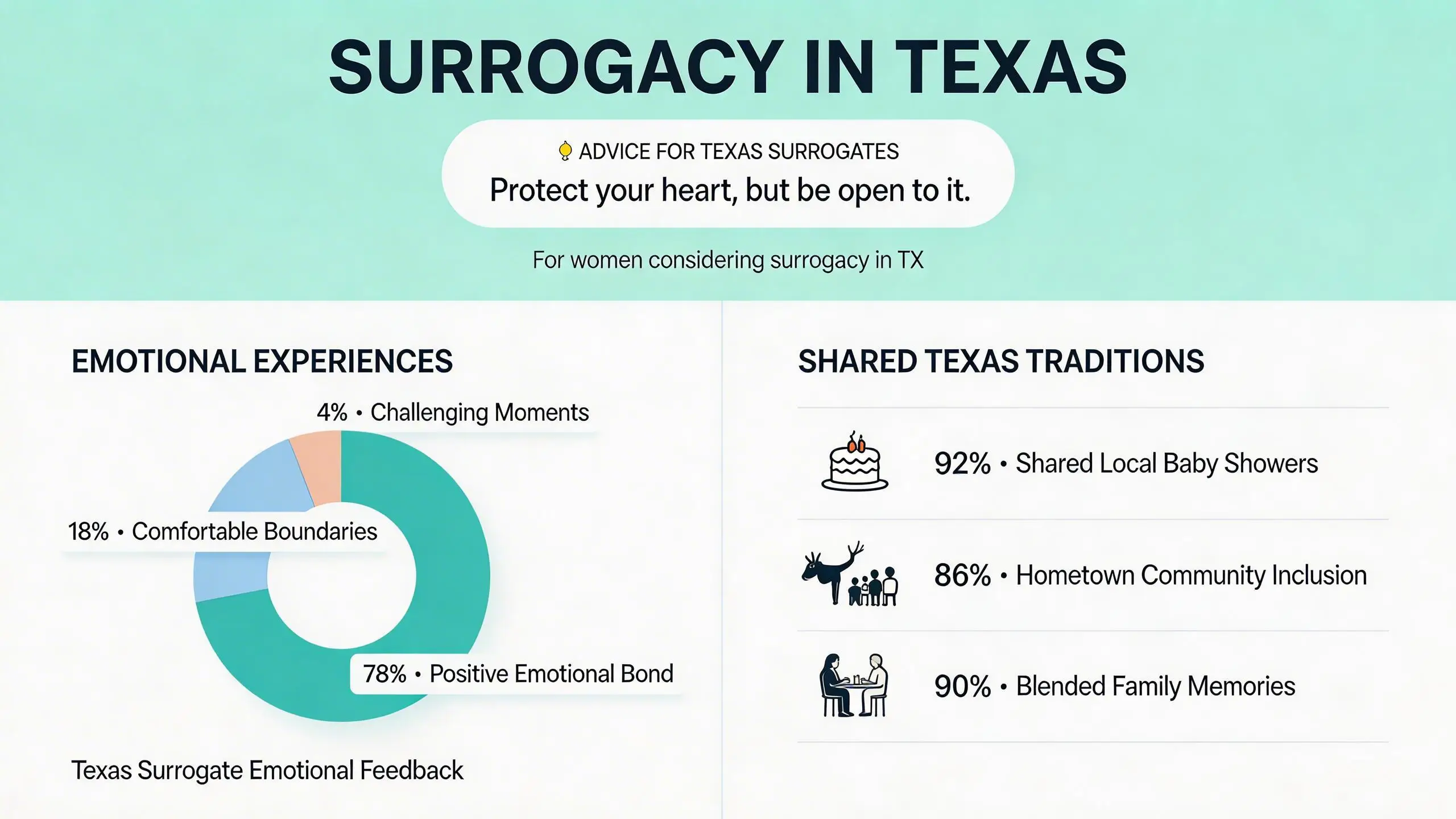
We also embraced some local traditions. They came to my hometown for a baby shower, which was a beautiful blend of my community and their family. Sharing these Texas traditions created shared memories that went beyond the pregnancy itself.
4. Managing Boundaries with Heart
Building a connection doesn’t mean having no boundaries. It means communicating them with kindness. Early on, I expressed that while I was happy to share my pregnancy journey, I needed some private space with my immediate family. They completely understood. The Texas surrogacy contract actually helped here—it clearly outlined everyone’s roles and expectations, which let us relax into the emotional parts without second-guessing the practical ones.
| Topic | My Approach | Outcome |
|---|---|---|
| Appointment Updates | Promised to share all medical details & fun updates post-appointment. | They never felt anxious or “out of the loop.” |
| Family Introductions | Introduced them to my children early to explain “Mommy is helping.” | Created comfort and understanding for my kids. |
| Post-Birth Contact | Openly discussed our hopes for updates and pictures after delivery. | We had a clear, happy understanding, avoiding future uncertainty. |
5. The Reward: A Lasting Bond
The moment I handed their newborn to them in the hospital room, every conversation, every shared worry, every laughed-together joke culminated in that profound instant. Our connection made the journey meaningful. Today, we still exchange holiday cards and the occasional picture. We share a bond that is uniquely ours, forged through the incredible journey of surrogacy right here in Texas.
My advice to any woman looking to become a surrogate in Texas is this: Protect your heart, but be open to it. The emotional connection with your intended parents can be one of the most rewarding parts of the process. It turns a profound act of generosity into a shared story of love and family.
Coping With Pregnancy Hormones and Emotional Changes as a Texas Surrogate
When I decided to become a surrogate in Texas, I knew the physical journey would be significant. But what surprised me, especially in my first trimester, was the sheer power of the emotional rollercoaster. The hormones that come with pregnancy are real, and when you’re carrying for intended parents, those feelings can get… complicated. It’s not just my body and my hormones; there’s this profound layer of responsibility and connection. Here’s what I’ve learned about navigating those emotional waves while being a gestational carrier under the supportive laws of Texas.
1. Acknowledging the “Surrogate-Specific” Emotional Layers
First off, it’s okay to feel a mix of things. One day I felt pure, joyful excitement for my intended parents in Dallas. The next, I was inexplicably weepy over a commercial, followed by a pang of anxiety: “Am I doing enough?” The key for me was to name and separate the feelings. I created a simple mental checklist:
- Is this a standard pregnancy hormone moment? (Like crying at a happy video).
- Is this a surrogacy-specific emotion? (Worrying about the upcoming medical screening in Houston or feeling pressure to have a “perfect” pregnancy).
- Is this just regular life stress? (Balancing appointments with my own kids’ schedules here in Texas).
This helped me communicate what I was feeling to my support system more clearly, instead of just saying “I’m overwhelmed.”
“The moment I gave myself permission to feel the full spectrum of emotions—without judging them as ‘right’ or ‘wrong’ for a surrogate—was the moment I found my emotional footing. This journey is human, not just clinical.”
2. Building Your Texas-Sized Support System
You cannot do this alone. Texas is a big state, but your support network needs to be bigger. My agency was fantastic at connecting me with other surrogates across the state—from Austin to San Antonio to Fort Worth. We had a private online group where we could vent about morning sickness or share the joy of a good ultrasound. This was invaluable because only another surrogate truly gets it.
I also leaned heavily on:
- My counselor: Many reputable Texas surrogacy agencies require or provide access to a mental health professional specializing in third-party reproduction. I used mine proactively, not just during screenings. We talked about setting emotional boundaries and processing the upcoming separation post-birth.
- My family: I sat down with my partner and kids early on. We used simple terms: “Mommy is helping another family have a baby, and sometimes the medicine that helps might make me extra tired or a little cranky.” Their understanding (as much as little ones can) made tough days easier.
3. Practical, Actionable Strategies That Worked for Me
When the emotions felt like a summer storm rolling across the plains, I had my toolkit ready:
| Emotion/Feeling | My Practical Coping Strategy | Texas-Specific Tip |
|---|---|---|
| Anxiety or Worry | Journaling. I wrote letters to the intended parents I hadn’t even met yet, which clarified my hopes for them. Also, controlled breathing (4-7-8 technique). | Take a walk in one of our many beautiful state parks. The wide-open spaces (like at Big Bend or a local nature trail) did wonders for my perspective. |
| Irritability/Frustration | Physical release. Prenatal yoga (found a great class in my area) or even just stretching. Also, clearly communicating to my partner: “I need an hour of quiet, no questions asked.” | Utilize telehealth! On rough days, I could chat with my agency’s social worker or my counselor via video call without having to drive across the metroplex. |
| Sadness or Weepiness | Connection. I’d call my surrogate buddy or look at pictures the intended parents had sent of the nursery they were preparing. It re-centered me on the “why.” | Indulge in a little non-guilty pleasure—like getting some amazing, authentic Tex-Mex (my comfort food). It’s about mindful enjoyment, not restriction. |
4. Communicating with Your Intended Parents Through the Shifts
This was a learning curve. Early on, I felt I had to be “upbeat” and “positive” in every update for my intended parents in California. But that wasn’t authentic. With guidance from my agency, we established a communication plan. I might send a text like: “Had a bit of a tough day with nausea, but baby’s heartbeat was strong at my check-up in Dallas today! Here’s the sonogram pic.” This kept them informed and involved without me feeling like I was pretending.
Remember, under Texas surrogacy law, you have a clear, legally-supported relationship. This clarity actually helped ease my mind. I wasn’t emotionally navigating an ambiguous relationship; we had a solid foundation of respect and roles defined by our contract, which freed me to focus on the genuine human connection.
5. The Post-Birth Hormonal Shift: Preparing in Advance
We talk a lot about pregnancy, but the drop in hormones after delivery is intense. Knowing that I would experience this and the emotional transition of handing the baby to his parents, I planned for it during my pregnancy.
- I arranged for extra help with my own children for the first two weeks postpartum.
- I scheduled regular check-ins with my counselor for the month following the birth.
- My intended parents and I discussed how we’d stay in touch those first few weeks—a few photos and updates meant the world to me as I recovered, reaffirming the beautiful outcome of our journey.
If you’re considering this path to become a surrogate in Texas, know this: your emotional journey is a valid and vital part of the process. Honor it, build your support fortress, and don’t be afraid to use every resource your agency and our great state offer. It’s what makes you not just a carrier, but an incredible, resilient part of creating a family.
Navigating the Post-Delivery Emotional Landscape: My Journey in Texas
Handing that beautiful, healthy baby to their parents in the delivery room here in Texas was one of the most profound moments of my life—a moment of pure joy and completion. But what I want to talk about honestly is what comes next. The post-delivery emotional adjustment is a real and significant part of the surrogacy journey. It’s not just a footnote; it’s a chapter. And here in Texas, with its supportive legal framework, I found I could truly focus on my own emotional well-being, knowing the intended parents’ rights were secure from the start.
1. The “Baby High” and the Natural Shift
Right after delivery, I was riding a wave of euphoria. I’d done it! The parents were overjoyed. We had our celebration in the hospital room. But a few days later, back at home in Houston, my body and mind began to recognize the shift. Even though I was intellectually prepared, my hormones were doing what they do after any pregnancy—they were plummeting. This isn’t a “surrogacy sadness”; it’s a biological reality of postpartum. I had to remind myself: my body just completed a marathon. Feeling physically drained and emotionally tender was normal and expected.
“My counselor told me something that stuck: ‘You are not grieving a loss. You are processing a successful completion.’ That reframe was everything for me.”
2. Leaning on My Support System & Professional Help
I cannot stress this enough: your support system is your lifeline. My agency here in Texas required that I have professional counseling throughout the process and for several months post-partum, and it was the best safeguard. My counselor was experienced in third-party reproduction and helped me navigate complex feelings without judgment.
I also relied heavily on:
- My Partner: He made sure I rested, listened when I needed to talk, and helped me remember to be gentle with myself.
- Fellow Texas Surrogates: My local surrogate group chat was buzzing post-delivery. Sharing our experiences—the happy tears and the random crying spells—made me feel completely normal.
- My Agency’s Aftercare: A good agency doesn’t disappear after birth. They checked in on me regularly, which made a huge difference.
3. The Unique Comfort of Texas Surrogacy Law
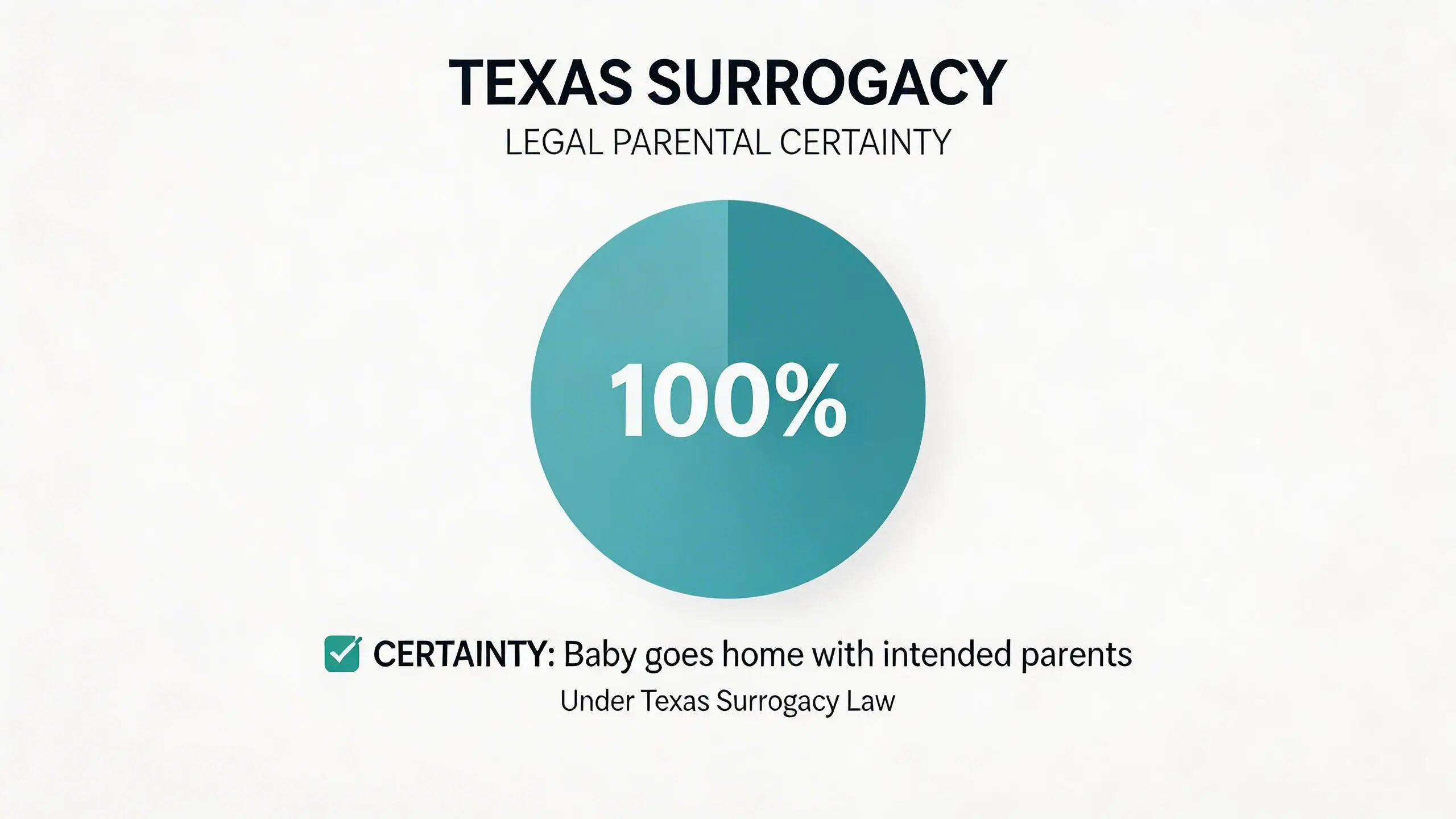
This is a Texas-specific peace of mind that aided my emotional adjustment immensely. Because Texas has clear, pre-birth order statutes, the legal parentage was established well before I delivered. There was no ambiguity, no waiting period, no court uncertainty after the birth. This meant:
| Emotional Benefit | How Texas Law Supports It |
|---|---|
| Closure and Certainty | I knew with 100% certainty the baby was going home with their parents. This allowed me to fully lean into my role and my own recovery. |
| No Lingering Legal Ties | My name was never on the birth certificate. This clean legal break, which I had agreed to and wanted, helped my mind and heart fully separate my “carrying role” from “parental role.” |
| Focus on Self-Care | Without legal loose ends, I could pour all my energy into resting, bonding with my own family, and healing. |
4. Managing the Relationship with the Intended Parents
Every relationship is different. Ours was very open. We texted photos for the first few weeks, which I loved—it was a joy to see the baby thriving. But we also mutually agreed to a little space for me to recalibrate. That was healthy. My advice? Communicate your needs before delivery. Have a loose plan. It’s okay to say, “I’d love updates, but I might need a week to just focus on my recovery first.” Most intended parents are incredibly understanding and grateful.
5. Practical, Actionable Steps for Your Adjustment
Based on my experience, here’s what I actively did to support my emotional health:
- Plan Your “You” Time: Before delivery, I scheduled a postpartum massage, lined up friends to bring meals, and booked a few sessions with my counselor for the month after.
- Honor Your Body: I treated my postpartum recovery with the same seriousness as if I had brought a baby home. Rest, nutrition, and gentle movement (like walks in my Austin neighborhood) were key.
- Journal: Writing down my feelings helped process the incredible journey I’d just completed. It’s a keepsake for me now.
- Celebrate Your Achievement: My family took me out to a nice dinner a month post-delivery. We celebrated *my* accomplishment. It was an important moment of recognition.
To any woman in Texas considering or completing this journey: the post-delivery period is a mix of pride, fatigue, hormonal shifts, and reflection. It’s a transition. Embrace the support available to you—from Texas law to your agency to your own community. Allow yourself to feel all of it, and know that this adjustment is a testament to the depth of the incredible thing you’ve just done.
My Lasting Legacy: The Long-Term Emotional Impact and Personal Growth
When I first decided to become a surrogate in Texas, I was focused on the logistics—the screenings, the legal process, the medical appointments. What I didn’t fully anticipate was how profoundly the experience would reshape me in the years that followed. The journey doesn’t end at delivery; in many ways, that’s when a new chapter of reflection and growth begins.
1. The Quiet Pride That Never Fades
Years later, I still carry a deep, quiet sense of pride. It’s not something I talk about every day, but it’s a core part of my identity now. Knowing I helped a Texas family grow in a way they couldn’t on their own is a permanent source of warmth. I’ll see a family playing at a park in Austin or Houston and think, “A family like that is out there, complete, because of what we did.” That feeling isn’t loud or boastful; it’s a peaceful certainty that I did something truly meaningful with my body and my heart.
“Surrogacy didn’t just give a family their child; it gave me an unshakable understanding of my own strength. That is a gift I get to keep forever.”
2. Navigating Complex Emotions After the Journey
Let’s be real—the emotional impact isn’t all sunshine. After delivery, even when you feel incredible joy for the parents, you might experience a hormonal crash or a sense of “what now?” I did. It’s a major life event, and your body and mind need time to recalibrate. In Texas, having a strong post-partum support plan isn’t just nice; it’s essential. This included:
- Continued counseling: My agency connected me with a therapist specializing in surrogate post-partum care.
- Surrogate support groups: Connecting with other Texas surrogates who “got it” was invaluable. We shared stories from Dallas, San Antonio, and the Rio Grande Valley, and it normalized all my feelings.
- Clear communication with the intended parents: We had agreed on the level of post-birth contact beforehand, which provided comfort and closure without guesswork.
3. The Personal Growth: How I Changed Forever
This journey forged a new version of me. The self-discipline through medications and appointments, the resilience during unexpected bumps, and the profound empathy developed for another family’s struggle—these are life skills. I learned to advocate for my health in medical settings and to set clear emotional boundaries, all within the protective framework of Texas surrogacy laws, which gave me confidence in the process.
| Area of Growth | Before Surrogacy | After Surrogacy |
|---|---|---|
| Self-Advocacy | Hesitant to question medical professionals. | Confident in discussing my care and needs openly. |
| Understanding of Family | Saw family in traditional terms. | Have a deeply expanded view of how families are created and bound by love. |
| Emotional Resilience | Unsure how I’d handle a high-stakes emotional process. | Know I can navigate complex emotions with grace and support. |
4. Integrating the Experience into My Life Story
Today, I’m a mother, a wife, a friend—and a surrogate. That role is integrated into my story. It comes up naturally when talking about life-changing experiences. It’s taught my own children about extraordinary kindness. The journey made me more patient, more grateful for my own family’s health, and more connected to my community of fellow surrogates here in Texas.
5. My Advice for Surrogates Considering the Long-Term Impact
If you’re looking to become a surrogate in Texas and are thinking about the lasting effects, here’s my heartfelt advice:
- Choose an agency that prioritizes your long-term well-being. Ask them about their post-partum support resources during your interviews.
- Journal your journey. I wrote letters to myself and to the baby. Reading them now is a powerful reminder of my headspace and my heart’s purpose.
- Embrace the entire emotional spectrum. Giving yourself permission to feel everything—pride, fatigue, joy, sadness, relief—is what leads to genuine growth and a positive long-term impact.
- Trust in Texas law. Knowing the legal process here is designed to protect you as the surrogate allowed me to fully invest emotionally without fear.
In the end, the decision to become a surrogate gifted me so much more than I ever expected to receive. It gifted me a stronger, more compassionate, and more confident version of myself. That’s a impact that lasts a lifetime.
Finding Your Village: My Go-To Resources for Emotional Support in Texas
Let me be real with you—the decision to become a surrogate in Texas is one of the most beautiful and complex things I’ve ever done. While the legal process here is wonderfully clear and the medical care is top-notch, no one really prepares you for the emotional waves. I learned quickly that having a strong, reliable support system wasn’t a luxury; it was my absolute lifeline. Whether you’re in Dallas, Houston, Austin, or a smaller town, here are the resources that carried me through.
1. Leaning on My Surrogacy Agency’s Support Team
My first and most constant layer of support came from my agency. A good Texas-based agency doesn’t just handle logistics; they provide a dedicated support team. My coordinator was my first call for any wobble, big or small. She wasn’t just a scheduler; she was a former surrogate who truly got it. She connected me with:
- In-house or affiliated counselors: Many agencies have therapists who specialize in third-party reproduction. I had several sessions covered by my agency, which was crucial for processing the complex feelings of attachment and separation.
- Peer matching: I was introduced to another surrogate in San Antonio who was a month ahead of me in the process. Texting with someone who was literally going through the same thing at the same time was invaluable.
“My agency counselor in Houston reminded me, ‘Your feelings are valid, even when they’re contradictory. It’s okay to feel proud, tired, connected, and ready to give this baby to its parents—all at once.’ That permission was everything.”
2. Texas-Based Surrogate Support Groups (In-Person & Online)
Sometimes, you just need to be in a room (or a Zoom room) with people who speak the language. While national online forums are great, finding groups with a Texas-specific focus was a game-changer. We could recommend local clinics, understand each other’s travel logistics for appointments, and even meet up for coffee.
| Group Type | How It Helped Me | Finding Them in Texas |
|---|---|---|
| Private Facebook Groups | Daily, anonymous support. Questions like “Any Houston surros have experience with XYZ clinic?” or “Feeling hormonal today, just need a vent!” were met with instant understanding. | Ask your agency for invites to vetted, private groups. Many are secret to protect members’ privacy. |
| Local Meet-Ups | Meeting surrogates and intended parents at agency-hosted picnics in Austin or casual dinners in Fort Worth made the journey feel less isolating. Seeing happy families post-surrogacy was incredibly motivating. | Events are often organized by agencies or through the larger Facebook groups. Keep an eye out for gatherings in major metro areas. |
3. Independent Therapists Specializing in Fertility & Surrogacy
While agency counselors are fantastic, I also wanted a therapist of my own, separate from the process. I sought out a licensed professional in Texas who listed fertility counseling or third-party reproduction as a specialty. This was my safe space to talk about everything—including any stress in my own family dynamics—without any connection to my agency or intended parents.
Pro Tip: Many Texas therapists now offer telehealth, so you aren’t limited to just those in your city. I found mine through the Mental Health Professional Group (MHPG) or by searching the American Society for Reproductive Medicine (ASRM) mental professional group directories.
4. The Support That Starts at Home (And How to Foster It)
My husband and kids were my core team, but they didn’t automatically understand the emotional landscape. I learned I had to communicate proactively. We used resources like:
- Books & articles: I shared simple articles with my family about the surrogacy journey so they could understand why I might be extra tired or emotional.
- Including them in appointments: Bringing my kids to a fun, early ultrasound where they could hear the heartbeat helped them feel connected and part of the “helping” mission.
- Setting clear boundaries with others: I had a simple, rehearsed response for acquaintances in my small Texas town who had… *a lot* of personal questions. “We’re so happy to be helping another family grow. It’s a beautiful journey!” usually sufficed.
5. Your Medical Team as an Emotional Resource
Never underestimate the nurses and doctors at your fertility clinic. The nurses at my clinic in Dallas were some of my biggest cheerleaders. They’ve seen it all. A quick, “I’m feeling really anxious about this next transfer,” often led to extra reassurance, a clearer explanation of the process, or just a much-needed pep talk.
“The day of my embryo transfer, the nurse held my hand and said, ‘You are doing something amazing today.’ That simple human connection, in the middle of a clinical procedure, centered me completely.”
Remember, choosing to become a surrogate in Texas means you’re giving an incredible gift, but you deserve to be supported, too. Building this toolkit of emotional resources—from professional counseling to the understanding nod from a fellow surrogate in your online group—isn’t just about surviving the journey. It’s about thriving through it, and looking back with pride on every step.