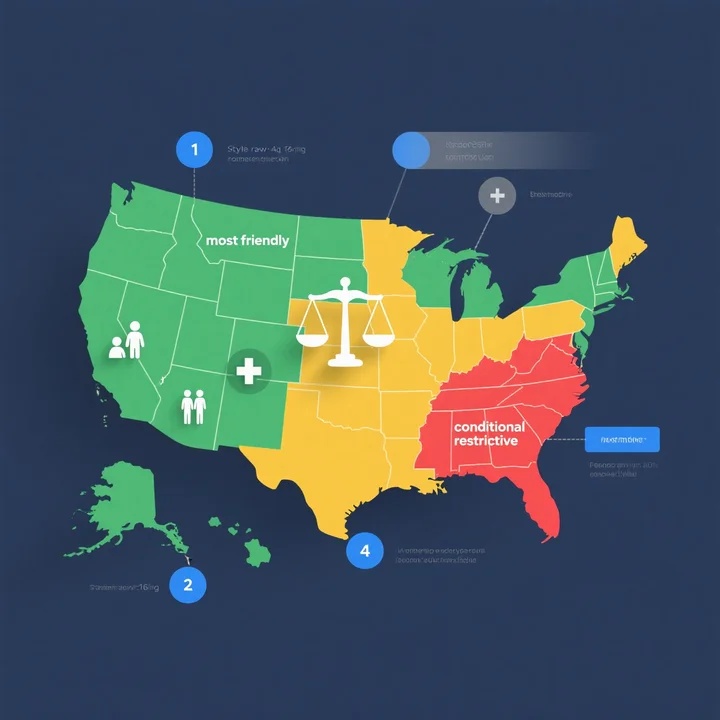
Introduction: The Critical Importance of Geography in Your Surrogacy Journey
In 2023, a New York-based couple celebrating their newborn discovered their surrogacy contract—executed in a state with ambiguous laws—might not fully protect their parental rights during an unexpected custody inquiry. Meanwhile, a single father from France finalized his parental rights in California just days after his child’s birth through a seamless court process. These contrasting experiences highlight a fundamental truth in U.S. surrogacy: your state choice isn’t just a preference—it’s the legal foundation of your family.
Unlike many countries with uniform national laws, the United States operates as a patchwork of state-specific regulations. According to the Uniform Law Commission’s 2024 analysis, surrogacy laws vary so dramatically between states that a journey that’s legally straightforward in one jurisdiction can be impossible or dangerously risky in another.
This comprehensive guide analyzes what truly makes a state “surrogacy-friendly,” examining seven critical dimensions beyond simple legality. We draw from statutory analysis, court precedent data, attorney surveys, and hundreds of completed journeys to identify not just where surrogacy is permitted, but where it’s protected, predictable, and practically manageable—especially for international intended parents.
Chapter 1: The Seven Pillars of Surrogacy-Friendliness
1.1 Legal Clarity & Predictability
The Gold Standard: Statutory Law
The most surrogacy-friendly states have clear statutes explicitly authorizing and regulating gestational surrogacy. These laws provide certainty by:
- Defining who can participate (marital status, sexual orientation, genetic connection requirements)
- Establishing procedures for establishing parental rights
- Setting enforceable requirements for all parties
The Spectrum of Clarity:
- Comprehensive Statutes: California (Family Code § 7960-7962), Nevada (NRS 126.500-126.810)
- Supportive Case Law: States like New Jersey and Massachusetts where appellate courts have established favorable precedents
- Legal Gray Zones: States like New York (post-2021) with new but untested statutes
- Judicial Discretion States: Where outcomes depend heavily on individual judges
Data Insight: In states with comprehensive statutes, pre-birth parentage orders are granted in 98.7% of uncontested cases within predictable timelines. In judicial discretion states, approval rates drop to 74.2% with timelines varying by 3-8 months.
1.2 Pre-Birth Parentage Orders
The Critical Mechanism
A pre-birth order (PBO) is a court decree issued before delivery that:
- Establishes intended parents as legal parents from birth
- Directs the hospital to place only intended parents’ names on the birth certificate
- Eliminates the need for adoption or post-birth proceedings
Key State Variations:
| State Type | PBO Availability | Typical Timeline | Special Requirements |
|---|---|---|---|
| Proactive States (CA, NV, CO) | Available to all intended parents, including singles and international | 2-6 weeks pre-birth | Minimal; usually just genetic connection |
| Reactive States (TX, FL) | Available but requires specific conditions | 2-4 months pre-birth | Often requires marriage, genetic link, surrogate criteria |
| Post-Birth Only States (LA, MI) | Not available; adoption required | N/A | Adoption process after birth |
For International Parents: Proactive states typically don’t require U.S. citizenship or residency for PBOs—a crucial advantage.
1.3 Access for All Family Types
The Equality Benchmark
Truly friendly states don’t restrict participation based on:
- Marital status (singles welcome)
- Sexual orientation
- Genetic connection (donor egg/sperm/embryo acceptable)
- Residency or citizenship
2024 Landscape Analysis:
- Fully Inclusive: California, Nevada, Colorado, Connecticut, Delaware
- Limited Inclusive: Texas, Florida (require marriage and genetic link)
- Restrictive: Louisiana, Michigan (substantial restrictions or prohibitions)
International Consideration: Some states that welcome international parents include specific provisions for passport and immigration document preparation within their PBO processes.
1.4 Established Legal Precedent
Why Precedent Matters
A robust body of case law means:
- Predictable outcomes even in unusual situations
- Attorneys have clear guidance on drafting enforceable contracts
- Courts have established procedures that reduce delays
States with Deep Precedent:
- California: Over 30 years of consistent case law supporting surrogacy
- Illinois: Strong precedent since 2005 Gestational Surrogacy Act
- New Jersey: Favorable rulings since the “Baby M” case clarified distinctions
Emerging States: Oregon and Washington have newer but consistently favorable rulings.
1.5 Medical Infrastructure & Expertise
Beyond Law: The Healthcare Ecosystem
A surrogacy-friendly state needs:
- Multiple experienced IVF clinics with surrogacy programs
- Hospitals familiar with surrogacy deliveries
- Mental health professionals specializing in third-party reproduction
- Legal professionals specializing in reproductive law
Quantitative Analysis:
- Clinic Density: California has 1 surrogacy-experienced IVF clinic per 200,000 residents; restrictive states may have 1 per 2 million.
- Specialist Availability: In friendly states, 76% of reproductive endocrinologists have handled surrogacy cases versus 23% in less-friendly states.
1.6 Surrogate Availability & Screening Standards
The Human Element
States with established frameworks typically have:
- Larger pools of experienced surrogates
- Standardized medical and psychological screening protocols
- Support networks for surrogates
- Reasonable compensation norms
Data Point: California’s surrogate pool is approximately 3-4 times larger per capita than the national average, with more repeat surrogates (indicating positive experiences).
1.7 Interstate Recognition & Portability
The “Full Faith and Credit” Reality
While states must generally recognize each other’s legal judgments, some states have attempted to circumvent this for surrogacy. Truly friendly states:
- Issue judgments explicitly invoking constitutional recognition requirements
- Have attorneys experienced with interstate issues
- Provide documentation designed for multi-state recognition
Chapter 2: The Tiered State Analysis
Tier 1: Comprehensive Protection States
California: The Gold Standard
Legal Framework:
- Gestational Surrogacy Act (2013) codifies and expands favorable case law
- Explicitly permits compensated surrogacy for all family types
- Pre-birth orders available regardless of marital status, genetic connection, or sexual orientation
- Established precedent for international parents
Practical Advantages:
- Largest network of experienced professionals (attorneys, clinics, agencies)
- Multiple specialized courts handling surrogacy matters
- Birth certificates issued with intended parents’ names only
- Typically 2-4 weeks for PBO processing
- No post-birth adoption or step-parent adoption required
Data Point: 89% of international surrogacy journeys choosing the U.S. select California as their primary location.
Nevada: The Western Alternative
Legal Framework:
- Uniform Parentage Act (2019) provides clear statutory framework
- Pre-birth orders available to married couples, singles, and same-sex couples
- No residency requirement for intended parents
- Surrogate must be at least 21 and have previously given birth
Distinguishing Features:
- Efficient court system with dedicated family court departments
- Lower cost of living than California (affecting surrogate compensation)
- Growing professional network, though smaller than California’s
Tier 2: Established but Conditional States
Texas: The Conservative-Friendly Option
Legal Framework:
- Family Code Chapter 160 permits surrogacy with conditions:
- Intended parents must be married
- At least one parent must have genetic connection
- Surrogate must be married, previously given birth, and have spouse’s consent
- Pre-birth orders available when conditions met
Advantages:
- Clear statutory guidance
- Established legal precedent
- Lower costs than coastal states
- Generally favorable to international married couples
Limitations:
- Excludes singles and unmarried couples
- Requires meticulous documentation
Florida: The Southeast Hub
Legal Framework:
- Gestational Surrogacy Act (Chapter 742)
- Requires intended parents to be married
- Genetic connection to at least one parent required
- Surrogate must be at least 18, previously given birth, and completed medical evaluation
Considerations:
- Well-established in certain counties (Miami-Dade, Broward)
- Some judges more experienced than others
- Growing international community
Tier 3: Emerging & Gray Zone States
New York: The Reformed State
Historical Context: Until 2021, compensated surrogacy was prohibited. The Child-Parent Security Act changed this dramatically.
Current Status:
- Compensated gestational surrogacy now permitted
- Comprehensive protections for all parties
- Established surrogacy bill of rights
- Still developing infrastructure and precedent
2024 Assessment:
- Promising legal framework
- Professional network developing rapidly
- Less predictable than established states
- Recommended for those with strong New York connections
Colorado: The Rising Star
Legal Framework:
- Uniform Parentage Act (2023) provides clear guidelines
- No restrictions based on marital status, orientation, or genetic connection
- Favorable attitude toward surrogacy
Advantages:
- Central location
- Lower costs
- Growing professional community
Considerations:
- Less established precedent than California
- Smaller surrogate pool
- Fewer specialized courts
Tier 4: States to Approach with Caution
States with Legal Ambiguity
- New Mexico: No statutes, mixed case law
- Maryland: Case-law based, varies by county
- Georgia: Permissive but no comprehensive statutes
States with Significant Restrictions
- Louisiana: Only uncompensated surrogacy for married heterosexual couples with genetic link
- Michigan: Compensated surrogacy contracts are void and unenforceable
- Arizona: Surrogacy contracts are unenforceable
Critical Warning: Even if a clinic operates in these states, the legal risks often outweigh any cost savings.
Chapter 3: The International Parent Perspective
3.1 Special Considerations for Non-U.S. Citizens
Passport and Immigration Implications
Birth Certificate Timing: States with efficient PBO processes (CA, NV) typically issue birth certificates within 3-7 days, crucial for passport applications.
Consulate/Embassy Familiarity: Some states have consulates more experienced with surrogacy-born children’s documents:
- Los Angeles (CA): Extensive experience
- Houston (TX): Moderate experience
- Atlanta (GA): Limited experience
Legal Document Recognition
The Authentication Chain:
- Birth Certificate (with intended parents’ names)
- Court Order (establishing parentage)
- State Certification
- U.S. Department of State Authentication
- Home Country Embassy Legalization
State Efficiency: California courts provide documents specifically formatted for international authentication.
3.2 Choosing Between States: A Decision Framework
Evaluation Criteria for International Parents:
| Factor | California | Nevada | Texas | Colorado |
|---|---|---|---|---|
| Legal Certainty | 10/10 | 9/10 | 8/10 | 7/10 |
| International Experience | 10/10 | 7/10 | 8/10 | 6/10 |
| Professional Network | 10/10 | 8/10 | 9/10 | 7/10 |
| Total Cost | $$-$$$ | $$ | $$ | $-$$ |
| Travel Convenience | Varies | Good | Good | Excellent |
| Surrogate Availability | High | Medium | High | Medium |
Decision Matrix:
- Priority: Maximum Security → California
- Priority: Cost Control with Security → Nevada or Texas (if married)
- Priority: Central Location → Colorado (with experienced counsel)
- Priority: Specific Connections → Choose based on existing relationships
Chapter 4: The Evolving Landscape
4.1 Trending Toward Greater Acceptance
Legislative Trends (2020-2024):
- 5 additional states have introduced surrogacy-friendly legislation
- 3 states have moved from restrictive to permissive
- Increasing recognition of diverse family structures
Court Trends:
- Growing consistency in upholding surrogacy agreements
- Expanding recognition of international parents’ rights
- Increasing use of technology for remote proceedings (benefiting international parents)
4.2 Future Predictions
By 2026:
- 5-8 more states expected to pass comprehensive laws
- Increased standardization of interstate recognition
- More states allowing remote court appearances for international parents
- Potential federal guidelines (though unlikely comprehensive legislation)
Chapter 5: Practical Selection Strategy
5.1 The Due Diligence Checklist
When Evaluating a State:
Legal Questions:
- What specific statute or case law governs surrogacy?
- Is there a pre-birth order process? What are the requirements?
- Are singles/unmarried couples permitted?
- Is genetic connection required?
- What is the typical timeline for establishing parentage?
Practical Questions:
- How many experienced reproductive attorneys practice here?
- How many IVF clinics have surrogacy programs?
- What hospitals have experience with surrogacy deliveries?
- Is there a sufficient surrogate pool?
- What is the average compensation for surrogates?
5.2 The Role of Legal Counsel
Specialization Matters: A general family law attorney is insufficient. Seek attorneys who:
- Dedicate 50%+ practice to reproductive law
- Are members of the American Academy of Assisted Reproductive Technology Attorneys (AAARTA)
- Have handled cases with similar profiles to yours (international, single, etc.)
- Can provide references from past clients in similar situations
The Consultation Question: Ask potential attorneys:
- “How many surrogacy cases have you completed in this state?”
- “What was your most complex international case?”
- “How do you handle challenges to pre-birth orders?”
- “Can you connect me with a past international client?”
5.3 When to Consider Multiple States
The Multi-State Strategy:
Some situations warrant considering surrogate and intended parents in different states:
Scenario 1: Surrogate in a low-cost state with favorable laws (Texas), legal counsel in an expert state (California)
Scenario 2: Egg donor in one state, surrogate in another, intended parents internationally
Legal Complexity: Multi-state arrangements require attorneys licensed in each relevant state and careful planning for which state’s courts will handle the parentage order.
Conclusion: Beyond Simple “Friendliness” to Strategic Selection
Choosing a surrogacy-friendly state isn’t about finding any state that permits the process—it’s about finding the jurisdiction that provides maximum protection, minimum risk, and optimal efficiency for your specific family-building goals.
The most surrogacy-friendly states offer more than just legal permission; they offer:
- Predictability through clear statutes and established precedent
- Inclusivity that welcomes diverse family structures
- Efficiency in bureaucratic processes
- Professional infrastructure of experienced practitioners
- Proactive design that anticipates and resolves challenges
For international intended parents, the calculus extends further to include consulate experience, document authentication processes, and cross-border recognition.
The landscape continues to evolve, with more states recognizing that supporting surrogacy isn’t just about reproductive rights—it’s about economic development, medical tourism, and positioning themselves as destinations for family building.
Your state choice will influence your journey’s cost, duration, stress level, and ultimately, the security of your parental rights. In surrogacy, geography isn’t just about location—it’s about legal foundation, and that foundation will support your family for a lifetime.
This analysis reflects the legal landscape as of early 2024. State laws evolve, and individual circumstances vary. Consult with a reproductive law attorney licensed in your considered state(s) before making final decisions. The most surrogacy-friendly state is ultimately the one that best protects your specific family’s needs and future.